What Is Nitinol Used For?
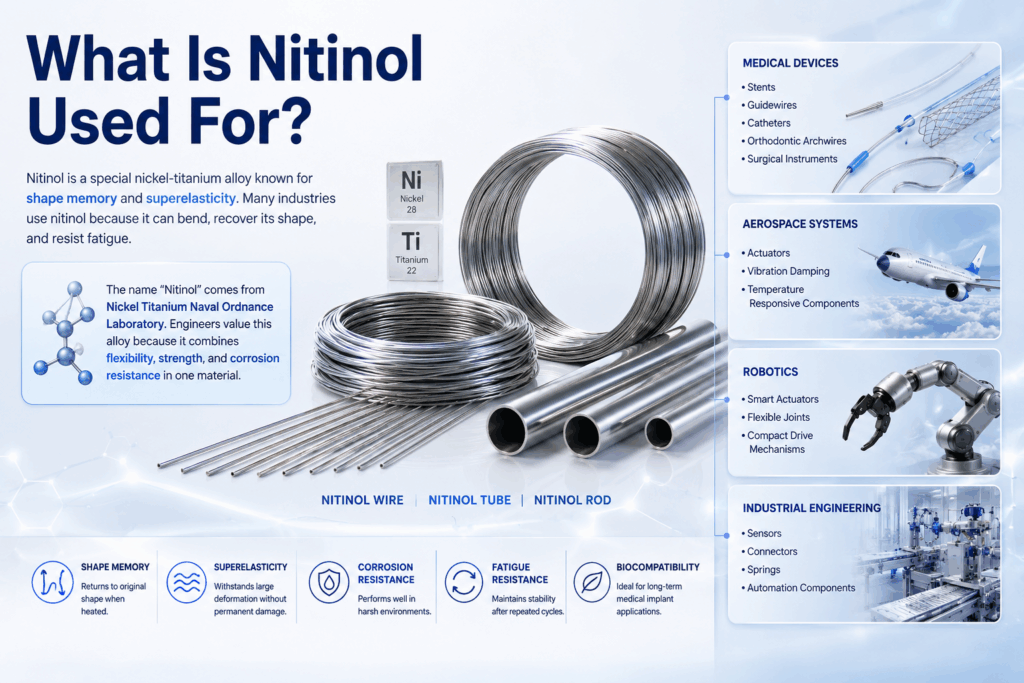
Nitinol is a special nickel-titanium alloy known for shape memory and superelasticity. Many industries use nitinol because it can bend, recover its shape, and resist fatigue. Today, nitinol plays an important role in medical devices, aerospace systems, robotics, and industrial engineering.
The name “Nitinol” comes from Nickel Titanium Naval Ordnance Laboratory. Engineers value this alloy because it combines flexibility, strength, and corrosion resistance in one material.
Medical Devices Are the Main Application of Nitinol
Medical technology is one of the largest markets for nitinol products. Doctors and engineers use nitinol because it can move through small and complex body structures without permanent deformation.
| Medical Device | Application |
|---|---|
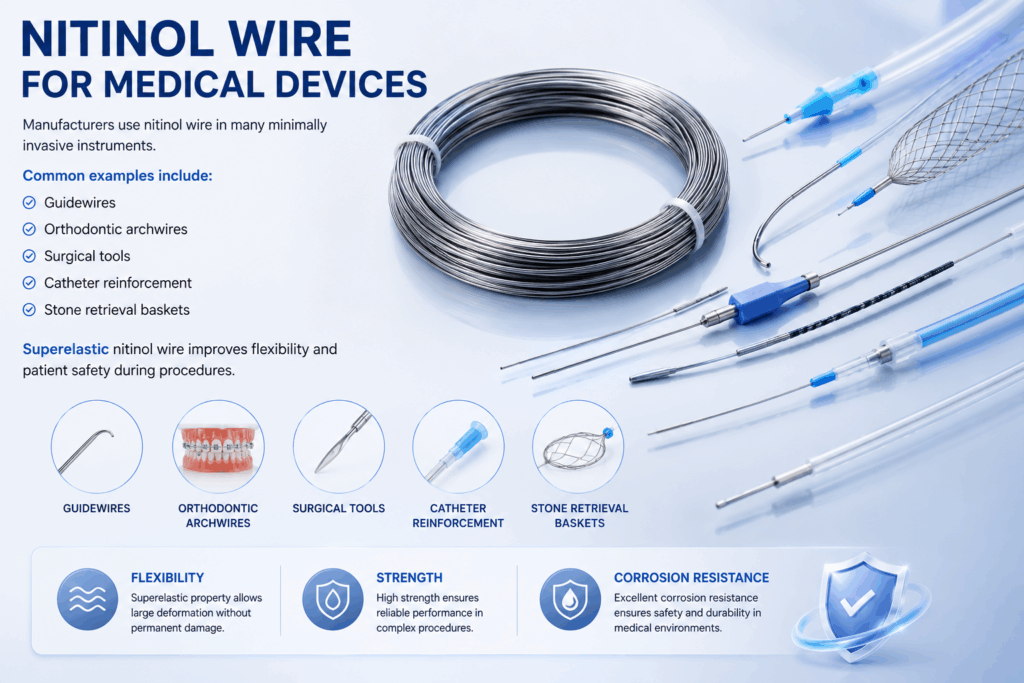
| Guidewires | Provides excellent flexibility and torque control for minimally invasive procedures. |
| Orthodontic Archwires | Delivers continuous corrective force while improving patient comfort. |
| Surgical Tools | Offers superior elasticity and fatigue resistance for precision instruments. |
| Catheter Reinforcement | Enhances flexibility, kink resistance, and navigation through complex anatomy. |
| Stone Retrieval Baskets | Maintains shape recovery and flexibility for reliable stone extraction. |
| Key Advantage | Superelastic nitinol wire improves flexibility, durability, and patient safety during medical procedures. |
Aerospace and Robotics Use
The aerospace industry uses for lightweight and temperature-responsive components. Engineers often install nitinol actuators inside aircraft systems because the alloy reacts to temperature changes.
At the same time, robotics companies use nitinol springs and wires to create compact movement systems. Shape memory motion helps robotic devices achieve flexible and precise control.
Industrial Applications of Nitinol
Many industrial manufacturers use nitinol in automation equipment and precision assemblies.
Common Industrial Uses Include
- Flexible couplings
- Temperature-sensitive switches
- Micro connectors
- Smart actuators
- Vibration control systems